

Growing up, I made sure to watch my words whenever my family called our Syrian relatives overseas. My mother, a Syrian Palestinian, would always warn me: “Be careful what you say. The government is always listening.”
My grandparents put it more bluntly. In Bashar al-Assad’s Syria, they said, “even the walls had ears.” It was a common phrase in the country for more than half a century.
Although I am half Egyptian on my father’s side, I have always felt a deep connection to Syria, despite the fact that I have yet to visit this wonderful country. My grandparents often spoke about its simplicity – the people’s warm and collectivist outlook, and the beauty of its landscape.
But they lived under the Assad regime’s yoke, a government that turned a once-thriving Middle Eastern country known for its textile industry and role as a trade hub, into one of the world’s most brutal police states.
It began with the Arab Socialist Ba’ath Party, a pan-Arab ultranationalist party that took control over Syria in a 1963 coup. One of the most powerful members of the party, then-Defense Minister Hafez al-Assad, overthrew his colleague, President Salah Jadid, ushering in decades of despotic and tyrannical family rule.
That ended on Dec. 8, 2024.
On that day, a diverse coalition of Syrian rebel factions entered the capital of Damascus. Assad’s son, Bashar al-Assad, who had ruled since 2000, fled to Russia.
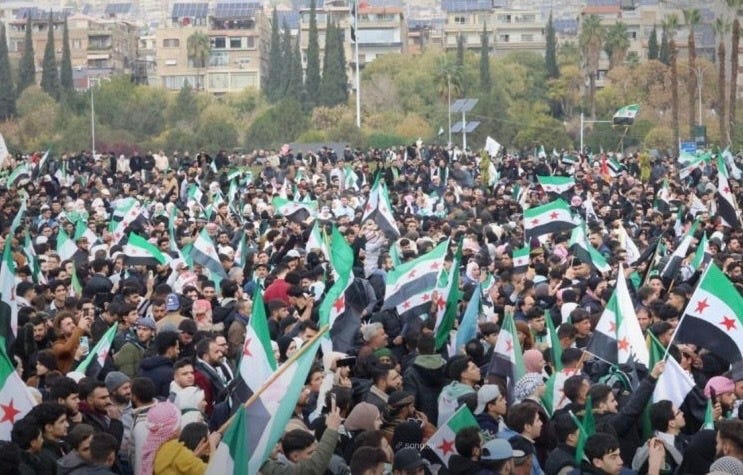
And last week, Syrians celebrated the first anniversary of Assad’s ouster with Liberation Day.
Videos on social media showed crowds filling cities like Homs and Hama, waving the green, white, black and red-starred Free Syria flag. In Damascus, fireworks lit the sky around Umayyad Square late into the night.
It took Syrians 54 years of patience – 14 of which was a bloody civil war that killed more than 600,000 people – to finally take a breath of fresh air without fear.
For decades, Syrians lived knowing one slip up in a conversation about the hardships under the regime could lead to disappearance in the middle of the night. Latest figures estimate that more than 300,000 Syrians were kidnapped by security services under the Assad regime, never to return.
That fear defined daily life.
Syrians were also celebrating the return of faith to public life. Syria is a moderately conservative society, and under the Assad regime, religious expression and public worship were often restricted, even for Muslims and especially for Christians. Today, many Syrians can practice openly again.
More than anything, however, Liberation Day represents hope. A hope for normalcy, electricity around the clock, more jobs and the stability that many people around the world take for granted. It also represents a hope for Damascus to once again become a center of regional trade and prosperity, not a center for economic isolation and poverty.
That hope remains fragile.
When the rebels assumed control of Syria, the coalition leader, Ahmed al-Sharaa, became president and created an interim government.
His background remains controversial, as he fought for Al-Qaeda in Iraq and Syria before splintering from the terror group after an alleged change of heart.
Despite this, many see him as a leader capable of stabilizing the country and balancing Islamic values with engagement with the West, which he is somewhat delivering. So far, the U.S. under President Donald Trump has lifted all economic sanctions against Syria that were levied during the Assad regime. Al-Sharaa even personally met Trump twice, the latest of which was at the White House last month, the first for any Syrian leader.
Trump told reporters “we all want Syria to become a successful country, and I believe he can do it,” adding that “we’ve all had rough pasts” in reference to al-Sharaa’s past al-Qaeda ties.
However, critics fear a new form of authoritarianism in Syria – an extreme, Islamist one – that would make many Syrians’ long fight for freedom be in vain. And they have good reason to be.
Aside from al-Sharaa’s past raising obvious concerns, particular incidents under his rule raise alarm.
Early this year, elements of his security forces killed nearly 1,500 people belonging to Shia Alawite minority, which the Assad family belonged to. And although al-Sharaa vowed to punish the perpetrators, including “even among those closest to us,” human rights organizations have criticized his government’s trials against suspects for lacking transparency.
Moreover, the constitutional declaration, which was signed in March and aimed to be used as Syria’s interim constitution, gives swathes of power to the executive branch, with observers arguing it could easily be used to undermine the rights of minorities.
Despite it all, one thing is certain: Syria is free of the Assad regime.
And whether or not the country will once again be ruled under another tyrannical regime is unclear. But for the first time in decades, Syrians can debate that future openly — without whispering, without fear and without worrying whether the walls are listening.