

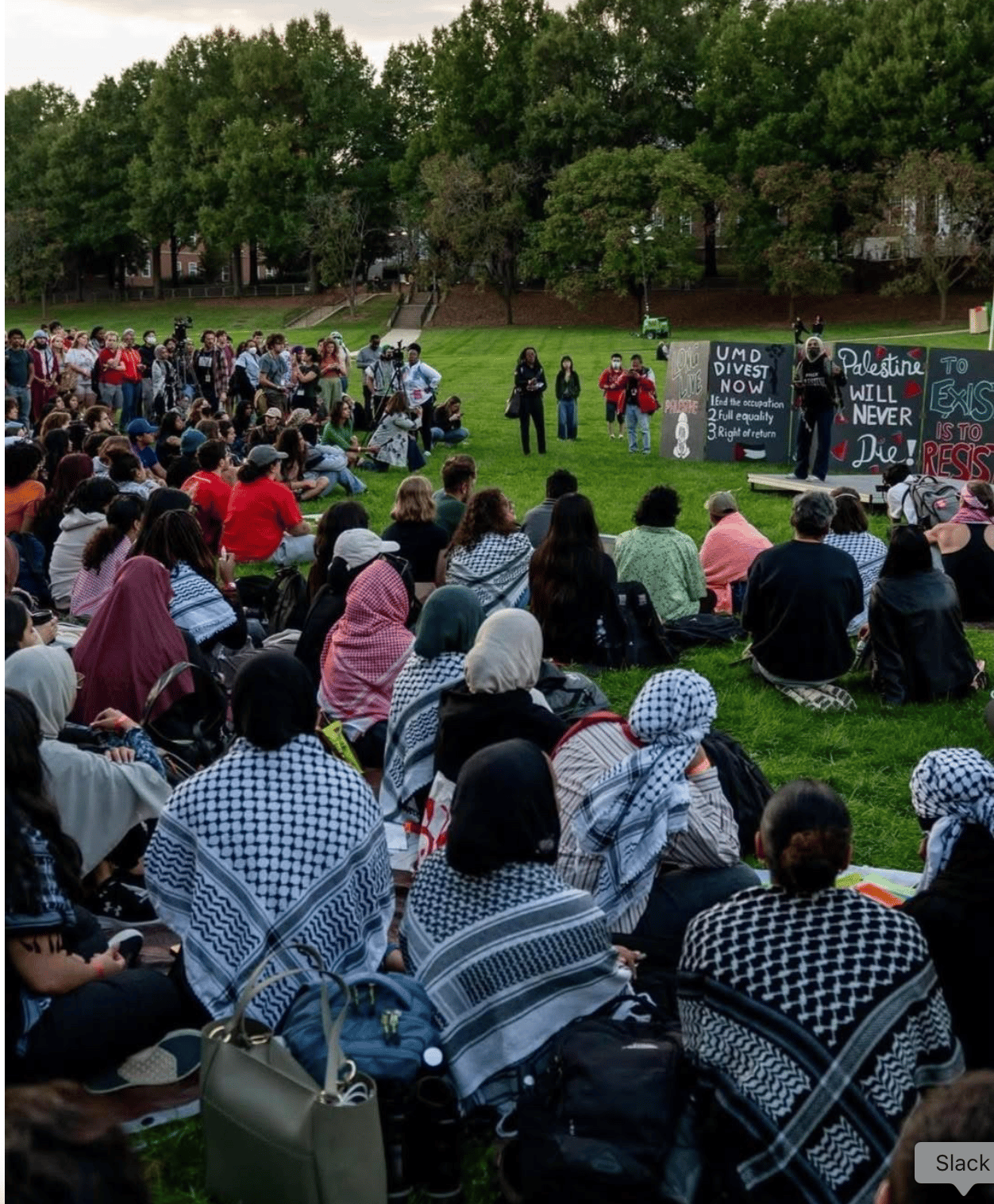
[Photo courtesy of Zyad Khan]
It was an interfaith vigil — part mourning, part resistance — for the lives lost in the Gaza Strip and Israel since Oct. 7, 2023. It was also an event that, just weeks earlier, the university had banned.
“In 2024 we had created a reservation for October 7 under the name of a vigil,” recalled Zyad Khan, vice president of UMD’s Students for Justice in Palestine chapter. “The purpose of the event was supposed to be an interfaith vigil, to be mourning Palestinian lives that were lost, but also Jewish lives lost.”
For Khan and his peers, the day marked more than grief. It was the culmination of a month-long battle over their right to hold it at all — a battle that would end with one of the most significant free speech settlements for pro-Palestinian students in U.S. history.
SJP had followed every campus procedure to reserve the space and gain administration approval, according to Khan. However, in early September that year, threats began pouring into the university — emails referencing the Ku Klux Klan, violent rhetoric about running over attendees, and promises to come to campus armed if the vigil went forward.
The pressure, Khan said, came “from the Zionists — threats that included threatening the vice president and mentioning the organization.”
On Sept. 1, 2024, UMD vice President Darryll J. Pines sent an email to the campus community: October 7 would be a “blackout day” for all student-led events, citing “unprecedented communications of a concerning and threatening nature” and a need for reflection on the anniversary. While the university’s police department, UMPD, had found “no immediate or active threat,” the administration concluded only university-sponsored events could proceed.
“It was very obvious that the whole free speech [issue] was covered to silence SJP,” Khan said. “There is evidence … that it was the Zionists alone who were threatening the campus community.”
Within weeks, two legal organizations, Palestine Legal and the Council on American-Islamic Relations (CAIR), sued on behalf of SJP, arguing the ban was unconstitutional. For Khan, there was no hesitation in going forward with the lawsuit because of its national implications.
“We had a chance to set a precedent for all pro-Palestinian speech in America,” he said. “We knew it’s just wrong to stay silent.”
On Oct. 1, 2024, a federal judge granted SJP a preliminary injunction, ordering UMD to permit the vigil. The court’s ruling affirmed that even politically charged slogans — including “From the River to the Sea, Palestine Will Be Free” — are protected speech.
Six days later, SJP gathered at the mall as planned. About 500 people attended, according to Khan. Counterprotesters stood outside the fenced perimeter waving Israeli flags, but the event remained peaceful.
“There were no arrests,” Khan said. “The intention of it was always to be peaceful … and the fact that the Zionists turned it into an event threatening the campus community, it’s clear on their nature.”
Over a year later, SJP would achieve another victory, unprecedented in pro-Palestine activism in the U.S. Last Wednesday, UMD agreed to pay the SJP $100,000 to settle the lawsuit — a sum Palestine Legal believes is the largest penalty a U.S. university has ever paid for violating pro-Palestinian students’ speech rights.
“This win is not just for Students for Justice in Palestine at the University of Maryland, but for all students speaking out for Palestinian freedom across the country,” said Tori Porell, a senior staff attorney at Palestine Legal.
The settlement also requires the university to affirm SJP’s good standing on campus — a symbolic victory for the group, which Khan says proves the conflict was about ideology, not safety.
“We won the battle of ideology,” he said. “As much as UMD wants to try to erase Palestine … students will not be silent.”
UMD did not immediately respond to a request for comment from @Islamic.
The SJP’s legal win comes as the humanitarian crisis in Gaza reaches what a U.N.-backed group called “the worst-case scenario of famine” in July.
According to Gaza’s Health Ministry, more than 227 Palestinians, including 100 children, have died from starvation since the Israeli siege began two years ago. U.N. officials have long warned that over a million people are at risk of famine, with aid trucks often blocked or delayed at crossings.
Additionally, more than 61,000 Palestinians in Gaza have been killed from Israel’s ongoing war, according to the ministry.
The scenes from Gaza — skeletal children in overcrowded hospitals, entire families buried in rubble — have galvanized protests from London to Istanbul and Sydney this year.
Over the past two months, several Western nations — including France, the U.K., Canada, and Australia — are expected to formally recognize Palestine at the United Nations General Assembly in September, signaling a rare shift in the diplomatic stance of Israeli allies.
While celebrating the legal victory, Khan was blunt about what he sees as a lack of courage from some Muslim communities — especially Muslim Student Associations (MSAs) at university campuses across the country.
“I think we have an issue with Muslim organizations,” Khan said. “MSA is obviously the big Muslim organization on a lot of campuses, but for most of them, there’s this fear — especially after October 7, and honestly since 9/11 — that speaking up for truth and justice will get you targeted. And yes, we’ve seen people targeted for it. But what this victory shows is that advocacy works. Advocacy is needed. Advocacy is part of Islam.”
While Khan did not explicitly mention the UMD MSA, the group did not immediately respond to a request for comment from @Islamic.
Khan emphasized that while community-building and social events are important, they cannot replace political action.
“If we’re not focusing on advocacy as students, we’re doing an injustice to our community, to Muslims as individuals,” he said. “Prayers are important. Boycotts are important. But there’s more we can do. We have an advantage — we have the Qur’an, we have the knowledge of Islam to guide us. We should be at the front lines of justice.”
Khan sees the case as part of a larger pattern of attempts to suppress pro-Palestinian advocacy on campuses nationwide. He hopes the outcome emboldens Muslim student organizations and allies to speak up, despite fear of backlash.
“For people in Gaza, there’s a lot more we can do here in the U.S.,” he said. “Whether your school has an SJP or not, you have to somehow push for advocacy in Palestine. When their purpose is silencing us, and we just sit back and do nothing, we’re doing a disservice to justice.
“We have momentum on our side. We have truth on our side. We know we are on the right side of history, and we have to do everything we can.”
Human Development Fund
The Human Development Fund (HDF) is dedicated to empowering communities through education, media, and sustainable development. As a proud sponsor of this newsletter, HDF supports independent storytelling and initiatives that drive positive change across the Muslim world. Learn more about their work and mission at hdfund.org.
FOLLOW US ON INSTAGRAM:
ISLAMIC ↗